Reviewed · FULL-DAY
ISTANBUL Full-Day PRIVATE Guided Tour: For the Top Historic Sites
Start with Istanbul’s biggest stories.
This private walking tour brings together the Blue Mosque, Hagia Sophia, Topkapi Palace, Basilica Cistern, Hippodrome, and Grand Bazaar in roughly six to seven hours. I like the personal pace, especially for families, solo visitors, and first-time visitors who want to ask questions without holding up a large group. I also like the way a good guide can connect Roman, Byzantine, and Ottoman Istanbul instead of treating each monument as a separate photo stop.
The main caution is cost. The $79 price covers the licensed guide, but museum admission, lunch, transport, and gratuity are extra. The day also involves a great deal of walking, and shopping demonstrations can become a concern if you want a strictly history-focused outing. Confirm your preferences with the guide before setting off.
In This Review
- Key points before you book
- Why this works well for a first day in Istanbul
- Blue Mosque: start with Ottoman grandeur
- Hagia Sophia: a building with several identities
- Topkapi Palace: allow two hours for the Ottoman court
- Basilica Cistern: Istanbul’s atmospheric underground room
- Hippodrome: the open-air Roman chapter
- Grand Bazaar: shopping, craft, and a little pressure
- How much walking and waiting should you expect?
- Guide quality is the deciding factor
- Is $79 a good value?
- Who should book this Istanbul tour?
- Should you book it?
- FAQ
- How long does the Istanbul private tour last?
- What sights are included?
- Where does the tour start?
- Where does the tour end?
- Are entrance fees included?
- Is lunch included?
- Is transportation included?
- What should women wear at the mosques?
- What should men wear at the mosques?
- Is the tour suitable for people with limited fitness?
- Is Topkapi Palace open every day?
- Is the Grand Bazaar open on Sundays?
- Is the tour private?
- What language is offered?
- Can I cancel for a full refund?
Key points before you book
- Six major sights in one historic district: You cover the city’s most important Old Istanbul monuments without spending the day crossing town.
- A genuinely private format: Your group sets the pace, asks the questions, and can often shape the emphasis of the day.
- Topkapi takes the most time: Plan on about two hours here, with ticket costs added to the tour price.
- Wear proper mosque clothing: Women need a headscarf and clothing covering the knees. Men need long trousers.
- The Grand Bazaar can be useful or distracting: You may see carpet weaving, ceramics, and haggling, but state clearly if you do not want shopping presentations.
- Expect a walking day: One visitor recorded 14,750 steps, while another advised comfortable shoes and water.
Why this works well for a first day in Istanbul
I see this tour as an orientation day for the historic peninsula. The sights are close enough to link on foot, yet each belongs to a different chapter of the city’s past. In one day, you move from a Roman chariot-racing arena to a Byzantine cathedral, an Ottoman palace, an imperial mosque, an underground reservoir, and a centuries-old market.
That range is the tour’s best feature. You do not need to work out the order yourself, decipher museum signs, or keep checking a map. A private guide can explain why the same city became Constantinople, then Istanbul, and how Roman, Byzantine, and Ottoman layers still sit beside one another.
The private setup matters most when your group has different interests. You can spend longer on Topkapi’s palace rooms, ask more questions about religious architecture, or keep moving if teenagers have reached their monument limit. Families praised guides who adjusted the pace for children, while solo visitors appreciated having the day shaped around their interests.
There is no dedicated vehicle included. The official meeting point is outside Hagia Sophia Grand Mosque at Sultan Ahmet, Ayasofya Meydanı No:1. The activity ends back there. Some experiences described hotel pickup, but that is not part of the stated inclusions, so confirm the meeting arrangement before the day begins.
A few more options to weigh up in Istanbul
- Istanbul: Bosphorus Dinner Cruise & Show with Private Table
★ 4.8 · 44,561 reviews - Istanbul: Daytime or Sunset Sightseeing Cruise & Audio Guide
★ 4.8 · 14,430 reviews - Istanbul: Bosphorus Dinner Cruise with Turkish Night Show
★ 4.8 · 10,127 reviews
Blue Mosque: start with Ottoman grandeur
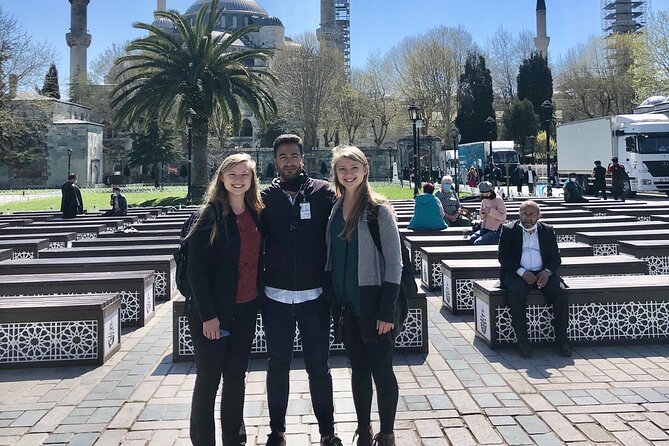
The Blue Mosque is usually the first major stop, with about 30 minutes inside and around the surrounding square. Built in the 17th century by the Ottoman Empire, it is famous for roughly 20,000 blue ceramic tiles and its stained-glass windows.
The nickname is easy to understand once you look upward. The tiles give the interior its character, but the visit is also about seeing a functioning imperial mosque rather than just an old building. Your guide can help you understand the layout, decoration, and role of the mosque in Ottoman Istanbul.
Entry is free, but this is an active religious site. Women need a headscarf and clothing that covers the knees, while men need trousers covering the knees. Plan for respectful clothing before you arrive, rather than relying on a last-minute fix.
Thirty minutes is enough for an introduction, though it may feel brief if you want quiet time for photographs or detailed architectural study. The mosque’s opening conditions can also affect the visit, since worship takes priority. A private guide is useful here because you can ask questions while remaining aware of the religious setting.
Hagia Sophia: a building with several identities
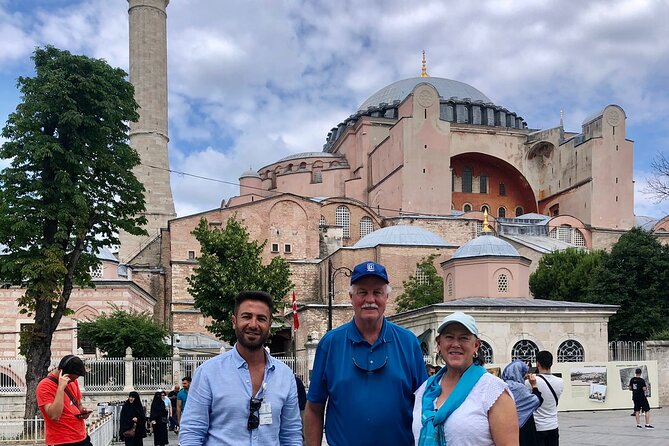
Hagia Sophia follows, with about 40 minutes suggested for the visit. Its huge dome has dominated Istanbul for around 1,500 years, and its story is unusually layered. It began as a cathedral built by the Eastern Roman Empire in the sixth century, served as a cathedral for about 1,000 years, and became a mosque after the Ottoman capture of Constantinople in 1453.
Today, it is partly used as a mosque and museum. Inside, you may see Roman-period icons and motifs alongside Ottoman additions. That mixture is what makes the building so important. It is not simply an old church or simply an old mosque. It records several changes in power, faith, and artistic taste.
Admission is not included. The stated information does not promise guaranteed queue-free entry, although several visitors found that their guide helped them obtain tickets and move through entry areas faster. Treat that as a possible benefit rather than a certainty, since lines and access rules can change.
The same clothing rules apply here: women need a headscarf and clothing covering the knees, and men need trousers covering the knees. A 40-minute visit gives you a useful overview, but you should not expect to examine every detail of this enormous building.
Topkapi Palace: allow two hours for the Ottoman court
Topkapi Palace is the longest stop, at about two hours, and it deserves the time. Sultan Mehmet II built the palace in the 15th century after the Ottoman conquest of Constantinople. It served as the residence of Ottoman sultans and the imperial center of an empire that lasted roughly 600 years.
The palace is a large complex rather than a single grand room. You move through rooms and displays containing objects from the Ottoman period. The appeal comes from seeing how court life operated, how the palace was arranged, and how much authority was concentrated within these walls.
Several people particularly valued this stop because the guide added context to the palace rooms and collections. One account described spending most of the day’s indoor sightseeing here and walking through many parts of the complex. That is a good clue about pacing: Topkapi can easily absorb your attention, but it can also make the rest of the day feel rushed if you linger too long.
Admission is extra, and one visitor estimated total entrance fees at about $130 per person for all the paid stops, with Topkapi alone costing around $60 at that time. Prices can change, so use that figure only as a warning to budget carefully. The tour’s $79 fee is not the full cost of the day.
Topkapi Palace is closed on Tuesdays. Tour guides cannot accompany visitors into some large private exhibition rooms because of the way guided groups are managed. That means you may explore some areas independently, even on a private tour. Ask your guide which rooms will be guided and which you will see on your own.
A completely different kind of day out:
- Best of Istanbul 1, 2 or 3-Day Private Guided Istanbul Tour
★ 5.0 · 8,922 reviews - Istanbul: Basilica Cistern Fast-Track Entry and Audio Guide
★ 4.6 · 7,521 reviews - Istanbul: Hagia Sophia Skip-the-Line Ticket & Museum Option
★ 3.7 · 4,958 reviews - Istanbul: Hodjapasha Whirling Dervishes Show & Exhibition
★ 4.4 · 4,790 reviews
Basilica Cistern: Istanbul’s atmospheric underground room
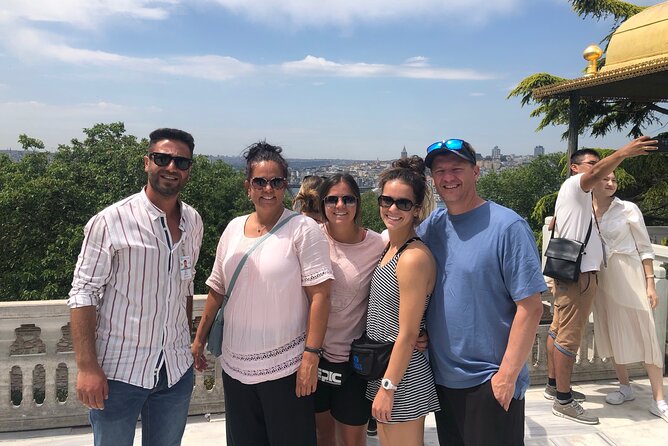
The Basilica Cistern is a short visit of about 30 minutes, but it may be the most atmospheric stop. Built by the Roman Empire in the sixth century as an underground water reservoir, it is now a museum rather than an active tank.
You descend about 10 meters underground and enter a space filled with pillars and colored lighting. The mood is very different from the mosques and palace above. This is a place where the city’s infrastructure becomes the attraction, showing how Roman engineers helped supply water to Constantinople.
The cistern has also appeared in From Russia with Love and Inferno, the latter based on Dan Brown’s novel. Those film connections may add interest, but the real reason to visit is the scale and mystery of the underground chamber.
Admission is not included. Thirty minutes should give you time to see the main interior, take in the columns, and hear the basic story. If this is the stop you most want to linger over, tell your guide early. Several people found the cistern especially memorable, and it would be a shame to hurry through it simply because the schedule is tight.
Hippodrome: the open-air Roman chapter
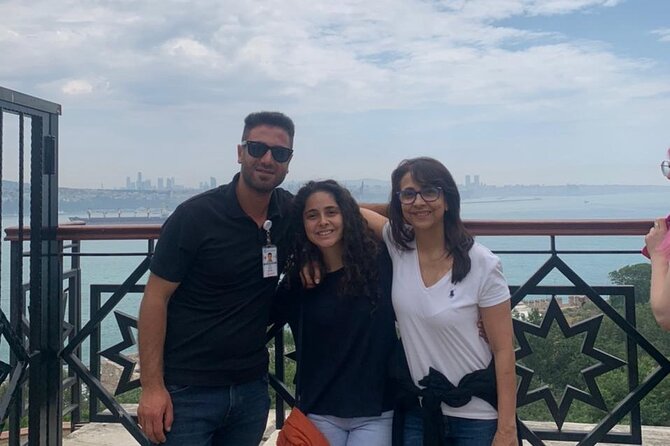
The Hippodrome is a 20-minute stop in a public square beside the major monuments. Emperor Constantine the Great built it in the fourth century after making the city the new capital of the Roman Empire.
The arena once hosted chariot races, the city’s most popular public entertainment. Today, the original racing track is gone, but several important objects remain. You can see the Egyptian obelisk brought from Egypt, the Serpent Column from Greece, the German Fountain, and the Walled Obelisk.
This is an open-air stop, so there is no admission charge. It also gives your feet a short break from indoor sightseeing, though the guide’s explanation is what turns a simple square into an ancient sports venue. Look closely at the monuments rather than treating the Hippodrome as a passage between the Blue Mosque and Hagia Sophia.
Twenty minutes is a sensible introduction. It is not enough for a long archaeological lecture, but it gives you the setting and the main surviving landmarks.
Grand Bazaar: shopping, craft, and a little pressure
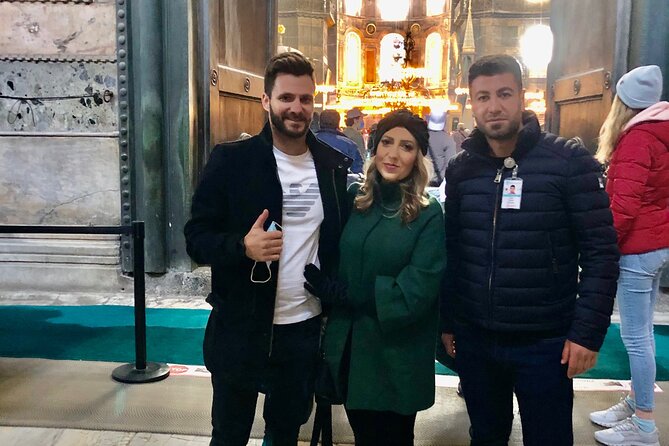
The Grand Bazaar is planned as the final major stop, lasting about an hour. Built in 1461 during the Ottoman period, it is a historic market with around 3,500 shops selling ceramics, spices, sweets, Turkish delight, jewelry, and handmade rugs.
This is where the private format can pay off. A guide may help you understand basic haggling, steer you through the maze, and explain the difference between materials such as wool, silk, and cotton. One person who bought carpets appreciated seeing handmade weaving and learning why silk pieces cost more than wool or cotton.
You do not need to buy anything. That point is worth stating clearly because the shopping side can change the feel of the day. The tour may include demonstrations of carpet weaving, silk spinning, or ceramics, and one visitor felt pressured during long sales presentations. Expensive plates and carpets were shown, including items priced in the thousands of dollars.
If you want shopping help, tell the guide what you are looking for and set a firm budget. If you want history only, say that at the start. A private guide should be able to adjust the plan, but direct communication matters.
The Grand Bazaar is closed on Sundays. It is also easy to lose track of time inside, so keep the final return time in mind. The market is free to enter, and its winding lanes are worth seeing even if you leave without a purchase.
How much walking and waiting should you expect?
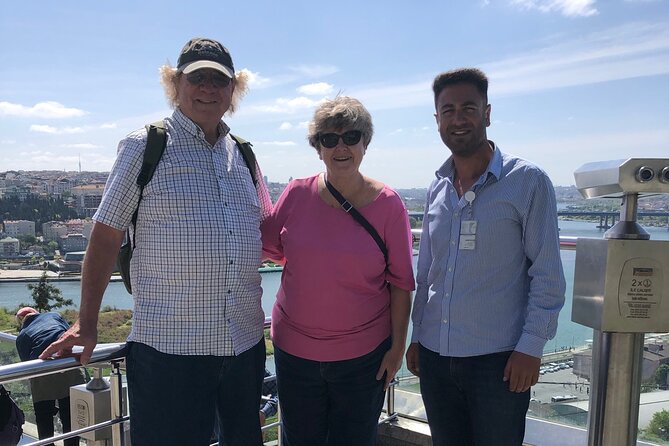
This is a walking tour, even though the day is sometimes described as a full-day experience. The official duration is about six to seven hours, and individual outings have lasted from roughly 9 a.m. to 2 p.m. or a little after 3 p.m. The exact length can change with questions, group age, crowd levels, and the amount of time spent at each sight.
You should be comfortable walking for most of the day. One person reported 14,750 steps, which is a useful reality check. Wear supportive shoes, carry water, and avoid planning a demanding evening immediately afterward.
The private format reduces some wasted time because you are not waiting for a large group. Some visitors were pleased that guides helped with ticket purchases and entry lines. Still, paid admission is extra, and there is no promise that every queue will be bypassed.
There are also stairs and uneven surfaces, especially around an underground cistern and large historic complexes. The tour requires a moderate level of physical fitness. If someone in your group has mobility concerns, ask the provider about the current route before booking.
Guide quality is the deciding factor
The experience depends heavily on the person assigned to your group. Several guides received warm praise for explaining religion, food, customs, and the city’s past in a way that made the buildings easier to understand.
Names that appear repeatedly in positive accounts include Fuat Peker, Sude, Yasin, Zel, Cüneyt, Emine, Hüsniye, also called Lucy, Nazli, Paulina, and a guide called Fuad. Fuat was praised for working well with teenagers, answering questions, and helping a family shape the day. Sude was appreciated for practical local advice and helping a solo visitor feel safe. Zel was singled out for clear explanations at Topkapi and Hagia Sophia.
The English-language guiding is offered in English, and the strongest experiences came from guides who adjusted the pace and explained why each place mattered. That is a much better use of a private tour than simply walking you from door to door.
There is one important balance point. One unhappy account felt that the historical explanations were too limited and that audio guides would have worked better at several sites. That criticism shows why you should be clear about your priorities. Ask for detailed history, cultural context, and questions if that is what you are paying for. Also state plainly if you do not want ceramic or carpet demonstrations.
Is $79 a good value?
At $79 per person, the price is reasonable for a private licensed guide covering six headline sights, particularly if you are traveling with two or more people. You are paying for planning, local explanation, and flexibility rather than for transport or admission.
The value is strongest for first-time visitors with only one day for the historic peninsula. You can see the core sights in a logical order and leave with a clearer sense of how Istanbul’s Roman, Byzantine, and Ottoman periods fit together.
The value weakens if you are traveling alone and intend to spend hours inside every museum. With tickets, food, transport, and gratuity added, the final bill can rise quickly. A solo visitor who wants a slow, specialist museum visit may prefer separate tickets and an audio guide.
For a family, the private arrangement can be worth the extra cost because you can stop for questions, adjust the pace, and avoid the strain of a large group. For a couple, it offers a simple way to cover the essentials without spending time on route planning.
Who should book this Istanbul tour?
I would choose this tour if you are visiting Istanbul for the first time, have six to seven hours available, and want the major historic sights explained in one day. It is also a good fit for families with older children or teenagers, solo visitors who prefer company, and small groups that value an adjustable schedule.
I would be more cautious if you dislike shopping stops, have limited walking ability, or want long, scholarly visits inside each monument. Ask about the guide’s approach and make your no-shopping preference clear before the tour begins.
Book around the closure days. Topkapi Palace is closed Tuesday, and the Grand Bazaar is closed Sunday. Free cancellation is available until 24 hours before the start time, while poor weather may lead to a new date or a full refund.
Should you book it?
Yes, if you want a well-organized introduction to Istanbul’s historic center and you value having a guide beside you. The strongest benefit is not simply seeing six famous places. It is understanding the connections between them while keeping the day private and flexible.
Book with realistic expectations about extra fees, walking, and the possibility of shopping demonstrations. If you confirm those details and receive a guide who matches the strong examples above, this is a useful, time-saving first day in Istanbul.
FAQ
How long does the Istanbul private tour last?
The tour lasts approximately six to seven hours. Individual outings may finish earlier or later depending on pace, questions, group age, and conditions at the sites.
What sights are included?
The tour includes the Blue Mosque, Hagia Sophia, Topkapi Palace, Basilica Cistern, Hippodrome, and Grand Bazaar.
Where does the tour start?
The stated meeting point is Hagia Sophia Grand Mosque, Sultan Ahmet, Ayasofya Meydanı No:1, 34122 Fatih, Istanbul, Türkiye.
Where does the tour end?
The activity ends back at the meeting point.
Are entrance fees included?
No. Museum entrance fees are not included. Admission to the Blue Mosque and Hippodrome is free, while Hagia Sophia, Topkapi Palace, and the Basilica Cistern require additional payment.
Is lunch included?
No. Lunch is not included in the tour price.
Is transportation included?
No. Transportation is not included. The experience is primarily a walking tour in Istanbul’s historic center.
What should women wear at the mosques?
Women need a headscarf and long clothing covering the knees. These rules apply to the Blue Mosque and Hagia Sophia.
What should men wear at the mosques?
Men need long trousers that cover the knees when entering the Blue Mosque and Hagia Sophia.
Is the tour suitable for people with limited fitness?
The tour requires a moderate level of physical fitness and includes extensive walking. Comfortable shoes and water are recommended.
Is Topkapi Palace open every day?
No. Topkapi Palace is closed on Tuesdays.
Is the Grand Bazaar open on Sundays?
No. The Grand Bazaar is closed on Sundays.
Is the tour private?
Yes. Only your group participates in the private activity.
What language is offered?
The tour is offered in English.
Can I cancel for a full refund?
Yes, if you cancel at least 24 hours before the experience start time. Cancellations made less than 24 hours in advance are not refunded, and late changes are not accepted.
Just added in Istanbul
- Private Tour: Istanbul’s Ottoman Experience Including Topkapi Palace and Blue Mosque★ 4.5 · 16 reviews
- Private Customizable Istanbul Day Tour with Licensed Guide★ 5.0 · 64 reviews
- IstanbulBasilicaCistern/fastEntranceEnglish/Spanish (not tickets)★ 4.0 · 184 reviews
- Private istanbul tour with transportation★ 5.0 · 36 reviews
- Private Old City Guided Tour★ 5.0 · 129 reviews
- Private Princes’ Islands Tour★ 5.0 · 56 reviews
- Private Bosphorus Cruise and Egyptian Bazaar with Motor Yacht★ 4.0 · 24 reviews
- Istanbul Private Tour Designed for Layover Flight, Transfer incl.★ 5.0 · 164 reviews
Full-Day, compared.
Full Day Cappadocia Red and Green Combined Day Tour
Read our review →
Full Day Cappadocia Tour( Red Tour + Underground City )
Read our review →
Full-Day Highlights Tour with Guide and Lunch
Read our review →

Full-Day Private Tour of Cappadocia’s Highlights (Car&Guide )
Read our review →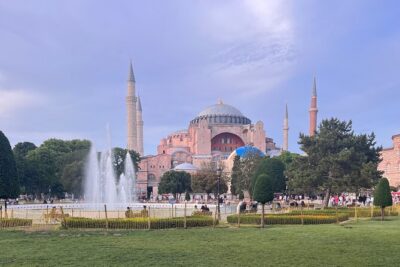
ISTANBUL BEST: Iconic Landmarks Full Day PRIVATE Guided City Tour
Read our review →