Reviewed · ISTANBUL TOURS
Istanbul: Whirling Dervishes Ceremony and Mevlevi Sema
Spin slowly, and Istanbul grows quiet. This one-hour Mevlevi Sema ceremony offers beautiful live music and a close look at an 800-year-old Sufi tradition in the Hoca Rüstem Medrese. I like the intimate setting and the calm, focused whirling. The main drawback is that there is little spoken explanation, so you should read about the ritual first or use the English audio guide.
The ceremony costs about $23 per person, which feels fair for a central Istanbul cultural experience lasting a full hour. It is not a theatrical show with narration, bright effects, or a staged finale. It is a religious ritual presented for an audience, and that distinction matters. Arrive early, sit quietly, and let the music do its work.
In This Review
- Key points to know before booking
- What the Mevlevi Sema ceremony means
- Entering the Hoca Rüstem Medrese
- The opening music and prayer
- When the dervishes begin to whirl
- Why the small format works, and where it falls short
- What the $23 price buys you
- Who will enjoy this most
- Simple ways to improve your visit
- Should you book the Istanbul Whirling Dervishes ceremony?
- FAQ
- Where does the Whirling Dervishes ceremony take place?
- How long does the ceremony last?
- How much does the experience cost?
- What is included in the ticket?
- Is hotel pickup included?
- Is there a live guide during the ceremony?
- What should I bring?
- How early should I arrive?
- Is the venue wheelchair accessible?
- Can I cancel for a refund?
Key points to know before booking
- The setting is a small medrese in central Istanbul: The Hoca Rüstem Medrese gives the ceremony an intimate, traditional feel, but limited seating means an early arrival matters.
- The first half centers on music: A small group of musicians performs instrumental music, singing, and prayer before the dervishes enter.
- The whirling is symbolic, not simply a dance: The ceremony expresses harmony with creation and the soul’s movement toward divine love.
- Tea is often served before the ceremony: It is a thoughtful touch, especially in cool weather, while you wait for the hall to open or the ritual to begin.
- You should not expect a live introduction: The English audio guide provides extra background, but you need a charged smartphone and headphones.
- The best seats go quickly: There are only a small number of rows, and a late arrival can leave you behind a pillar or with a blocked view.
What the Mevlevi Sema ceremony means
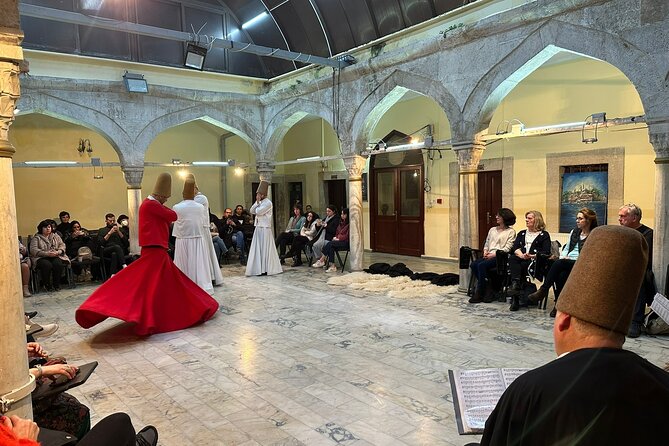
The Whirling Dervishes belong to the Mevlevi Sufi tradition of Islam, founded around the teachings of Mevlana Jelaleddin Rumi in the 13th century. The ceremony is called Sema, and the spinning is only one part of a carefully ordered spiritual practice.
For the Mevlevi, whirling reflects the motion found throughout creation. Day follows night. Seasons turn. Life gives way to death. Even the movement of blood reflects a constant cycle. The dervish turns as a way of seeking harmony with this larger order.
That meaning can be easy to miss if you arrive expecting a folk dance or a stage spectacle. The performers are not trying to impress you with speed. Their movements are measured, controlled, and inward-looking. The quiet concentration is part of what makes the ceremony so absorbing.
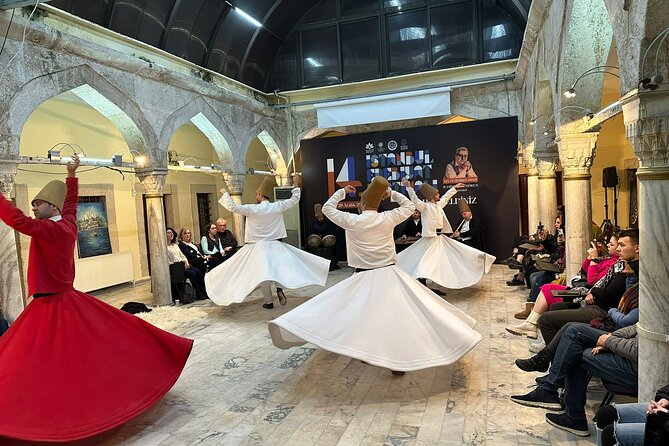
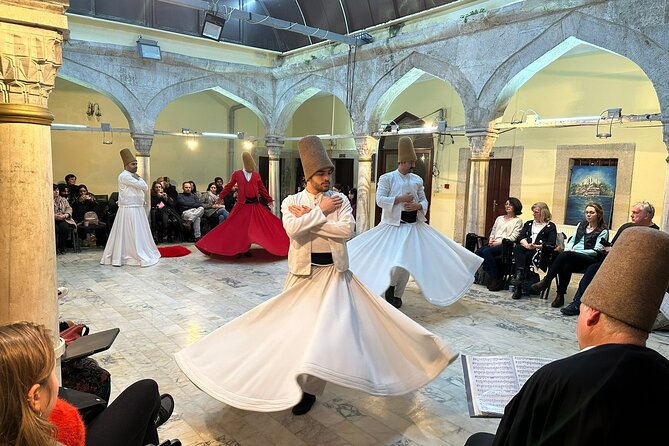
The clothing also carries meaning. The black cloak represents death or the shedding of the old self. Beneath it, the white robe suggests rebirth. The tall felt hat represents a tombstone for the ego. During the whirling, the right hand is traditionally lifted toward the sky to receive divine grace, while the left hand points downward, symbolically passing that grace to the earth.
You do not need to understand every detail to appreciate the ceremony. Still, knowing these basic symbols changes what you see. The spinning stops looking like a feat of balance and begins to look like a sequence of prayer and devotion.
A few more options to weigh up in Istanbul
- Istanbul: Bosphorus Dinner Cruise & Show with Private Table
★ 4.8 · 44,561 reviews - Istanbul: Daytime or Sunset Sightseeing Cruise & Audio Guide
★ 4.8 · 14,430 reviews - Istanbul: Bosphorus Dinner Cruise with Turkish Night Show
★ 4.8 · 10,127 reviews
Entering the Hoca Rüstem Medrese
The ceremony takes place at the Hoca Rüstem Medrese, in the Fatih area near Istanbul’s major historic sights. Its central position makes it easy to fit into a day of sightseeing, especially if you are already exploring the Sultanahmet area.
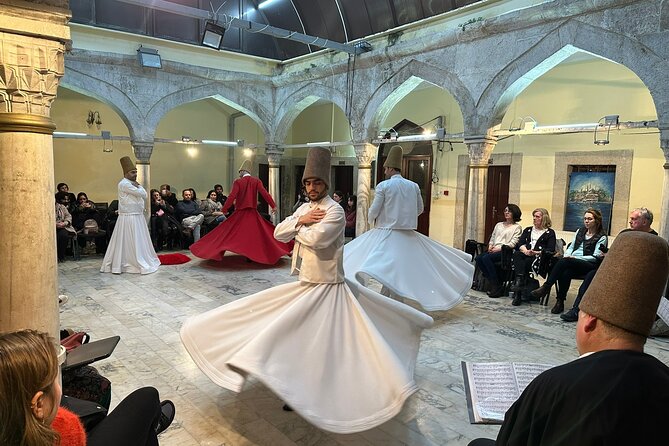
The venue is compact rather than grand. That is good news if you want to see the musicians and dervishes at close range. You are not watching from the back of a large auditorium. The small room creates a quieter, more personal mood.
It also creates a few practical limits. Seating is restricted, and the front rows fill quickly. Some seats may have a pillar or another obstruction in the way. If a clear view matters to you, arrive well before the required 15 minutes.
Several people have found the meeting point easy to reach, while others have wished for a clearer map. I would allow extra time if you do not know the narrow streets of Fatih. Arriving early removes the stress and gives you time to find the entrance, settle in, and choose your seat.
Tea may be offered before the ceremony. It is a simple but welcome detail, and it gives the waiting period a pleasant Turkish touch. Do not count on tea if you arrive at the last moment, since it is mainly served while people are gathering.
The opening music and prayer
The ceremony lasts one hour, but the dervishes do not appear immediately. The first section is devoted to music, chanting, and the opening prayer. Based on the usual timing, expect roughly 20 to 30 minutes of music before the whirling begins.
A trio of musicians performs on traditional instruments, accompanied by singing or recitation. The music establishes the mood slowly. It is not background music while you wait for the main act. It is an important part of the Sema itself.
This opening may be the most challenging section for anyone who wants constant action. The pace is deliberate, and there is no running commentary to explain what you are hearing. If you have prepared even a little, the music becomes easier to follow. If not, you may find the first half-hour quiet or even repetitive.
I recommend treating this part as a chance to settle down after the noise of Istanbul. Put away your phone, listen to the instruments, and watch the musicians’ concentration. The ceremony works through patience. It does not rush to entertain you.
The musicians are one of the most praised parts of the event. Their skill and serious approach help create the atmosphere that makes the later whirling so effective. Without this opening, the spinning would lose much of its religious and musical setting.
When the dervishes begin to whirl
The dervishes enter after the music and begin the Sema ritual. Their white robes widen as they turn, creating a gentle, almost floating effect. The movement is steady rather than dramatic, and the room often becomes very quiet as people watch.
The physical control is remarkable. The dervishes turn for an extended period while maintaining posture, balance, and a fixed sense of purpose. Their arms, hands, robes, and footwork follow a pattern. From a distance, the movement may look simple. From close by, you can see the discipline behind it.
The hall’s size helps here. In a small room, you can observe the performers without the distance found in a large theater. On the other hand, the room can feel crowded, and people in the back may have difficulty seeing the dancers’ feet. If you want to study the footwork, choose a front or side position.
Photography can be awkward. Back-lit side panels at either end of the hall may distract your eye and affect photographs. More important, a phone screen or camera can disturb the people around you. Take a few pictures if allowed, then put the device away.
Do not clap during the ritual. This is presented as a spiritual ceremony rather than a normal dance show. Applause may feel natural at the end, but quiet respect is the safer choice. Watch how the room behaves and follow the tone set by the organizers.
A completely different kind of day out:
- Best of Istanbul 1, 2 or 3-Day Private Guided Istanbul Tour
★ 5.0 · 8,922 reviews - Istanbul: Basilica Cistern Fast-Track Entry and Audio Guide
★ 4.6 · 7,521 reviews - Istanbul: Hagia Sophia Skip-the-Line Ticket & Museum Option
★ 3.7 · 4,958 reviews - Istanbul: Hodjapasha Whirling Dervishes Show & Exhibition
★ 4.4 · 4,790 reviews
Why the small format works, and where it falls short
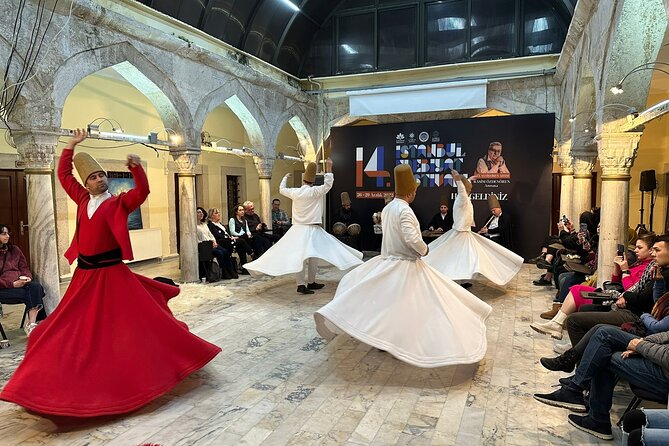
The ceremony’s strongest feature is its closeness. You are near the musicians and dervishes, and the modest room keeps the event from feeling like a large commercial production. Several descriptions of the setting point to its cozy, traditional character.
That intimacy also means the experience is not polished in the way a major theater production might be. You will not receive a long welcome talk, a historical lecture, or a detailed explanation of each movement. The hosts are generally friendly and helpful, but the ceremony itself begins without much instruction.
This is the biggest weakness for first-time visitors. You may wonder what the music means, why the dervishes bow, or how the different stages fit together. The audio guide helps, but it is on your own smartphone, not delivered live as part of the ceremony.
I suggest reading a short introduction before you go. Learn the basic meaning of the black cloak, white robe, tall hat, raised right hand, and lowered left hand. That small amount of preparation gives the ritual more shape without turning it into a classroom lesson.
The lack of explanation can also be a strength. The ceremony is allowed to remain quiet and uncluttered. You are not pulled out of the mood every few minutes by a guide speaking over the music.
What the $23 price buys you
At around $23, this is a reasonably priced way to spend an hour in central Istanbul. Your ticket covers admission to the ceremony and access to an English audio guide app. There is no hotel transfer, so you need to reach the medrese yourself.
The value depends on what you want. If you are searching for a fast, narrated introduction to Turkish culture, this may feel incomplete. If you want to sit quietly and watch a traditional Sufi ceremony in a small historic setting, the price is easier to justify.
You are paying for the venue, musicians, performers, and a carefully timed ritual rather than a long tour. There are no extra stops or filler activities. The one-hour length is useful on a packed Istanbul schedule, and the location makes it possible to combine the ceremony with nearby sights or dinner.
The flexible booking terms add practical value. You can reserve now and pay later, and cancellation is free up to 24 hours before the start time. Check the available starting times before you build your evening around it.
Who will enjoy this most
I recommend the ceremony to you if you enjoy traditional music, religious art, quiet observation, and cultural experiences that do not explain every moment for you. It suits an evening when you want something calmer than a restaurant or a crowded attraction.
It is also a good choice if you are curious about Islam and Sufism but do not have time for a longer cultural program. You will not become an expert in Mevlevi thought in one hour, but you will see an important part of its practice.
Families with older children may appreciate the visual quality of the whirling, although younger children who need constant movement may lose interest during the opening music. The ceremony also suits couples, solo visitors, and anyone looking for a reflective pause in the middle of a busy sightseeing day.
You may want to skip it if you expect a lively dance show, a running commentary, or a highly interactive activity. It is also a poor fit if sitting quietly for an hour sounds difficult.
The ceremony is wheelchair accessible, which makes it more practical for many visitors. Bring headphones and a charged smartphone if you want to use the audio guide. You must be in the hall 15 minutes before the start, though arriving earlier is the better plan for seating.
Simple ways to improve your visit
Read about the Mevlevi Sema before arrival. You only need the basics, but that preparation prevents the common feeling of watching something beautiful without knowing what it represents.
Arrive 30 to 40 minutes early if possible. Some people have arrived even earlier and still missed the very front seats, so do not assume the stated 15-minute arrival time guarantees a prime position.
Choose your seat with the room’s layout in mind. A front-row place gives you the clearest view of the footwork, while a back seat may give you a wider view of the full formation. Avoid sitting directly behind a pillar if you have a choice.
Keep your phone quiet and limit photography. The room is small, and screen light is more noticeable than you might expect. A respectful audience helps preserve the serious mood.
Finally, do not judge the first 20 minutes too quickly. The opening music is not an obstacle between you and the whirling. It prepares the atmosphere and shows that Sema is a complete ceremony, not a spinning exhibition.
Should you book the Istanbul Whirling Dervishes ceremony?
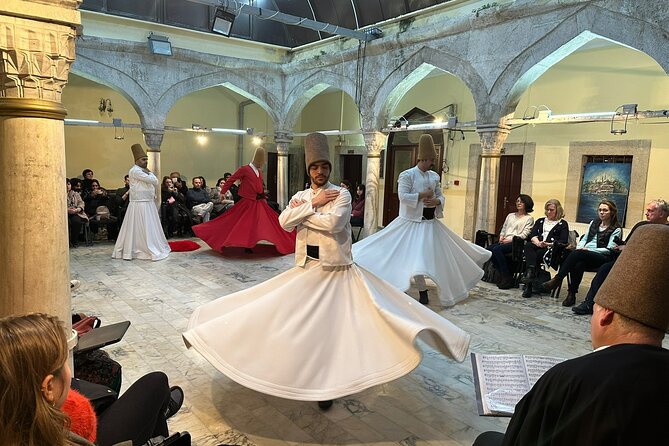
Book it if you want an intimate look at Sufi culture, strong live music, and a peaceful hour in a historic Istanbul setting. The combination of central location, modest price, tea before the ceremony, and a small hall makes it a practical cultural stop.
Go with the right expectations. You will not receive much live explanation, and the event may feel solemn rather than entertaining. Prepare beforehand, arrive early for a good seat, and treat the Sema as a religious ritual. If you do, the music and controlled whirling can become one of the most memorable quiet moments of your time in Istanbul.
FAQ
Where does the Whirling Dervishes ceremony take place?
It takes place at the Hoca Rüstem Medrese in central Istanbul, in the Fatih area of the Marmara Region of Turkey.
How long does the ceremony last?
The ceremony lasts one hour.
How much does the experience cost?
The listed price is $23 per person.
What is included in the ticket?
The ticket includes entry to the Whirling Dervishes ceremony and access to an English audio guide app on your smartphone.
Is hotel pickup included?
No. Hotel pickup and drop-off are not included, so you must make your own way to the venue.
Is there a live guide during the ceremony?
A host or greeter is available in English, but the ceremony itself does not include a detailed live explanation. An English audio guide is available through the app.
What should I bring?
Bring headphones and a charged smartphone if you plan to use the audio guide.
How early should I arrive?
You must arrive at the hall 15 minutes before the ceremony begins. Arriving earlier is recommended if you want a better seat.
Is the venue wheelchair accessible?
Yes. The activity is listed as wheelchair accessible.
Can I cancel for a refund?
Yes. You can cancel up to 24 hours before the activity for a full refund. You can also reserve now and pay later.
Just added in Istanbul
- Private Tour: Istanbul’s Ottoman Experience Including Topkapi Palace and Blue Mosque★ 4.5 · 16 reviews
- Private istanbul tour with transportation★ 5.0 · 36 reviews
- Private Customizable Istanbul Day Tour with Licensed Guide★ 5.0 · 64 reviews
- IstanbulBasilicaCistern/fastEntranceEnglish/Spanish (not tickets)★ 4.0 · 184 reviews
- Private Bosphorus Cruise and Egyptian Bazaar with Motor Yacht★ 4.0 · 24 reviews
- Private Old City Guided Tour★ 5.0 · 129 reviews
- Private Princes’ Islands Tour★ 5.0 · 56 reviews
- Istanbul Private Tour Designed for Layover Flight, Transfer incl.★ 5.0 · 164 reviews
Istanbul Tours, compared.
Bosphorus Dinner Cruise & Show with Private Table
Read our review →
Daytime or Sunset Sightseeing Cruise & Audio Guide
Read our review →
Bosphorus Dinner Cruise with Turkish Night Show
Read our review →
Best of Istanbul 1, 2 or 3-Day Private Guided Istanbul Tour
Read our review →
Basilica Cistern Fast-Track Entry and Audio Guide
Read our review →
Hagia Sophia Skip-the-Line Ticket & Museum Option
Read our review →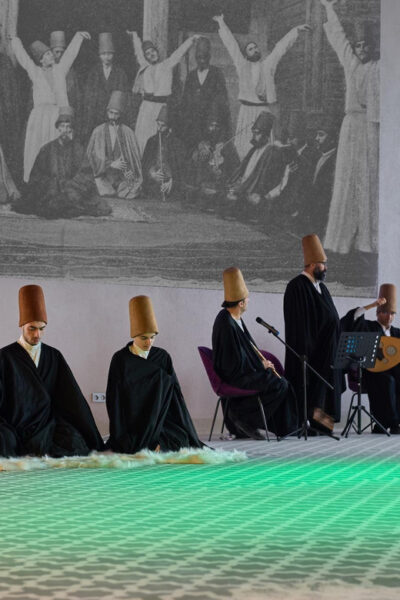
Hodjapasha Whirling Dervishes Show & Exhibition
Read our review →